MD Class of 2021
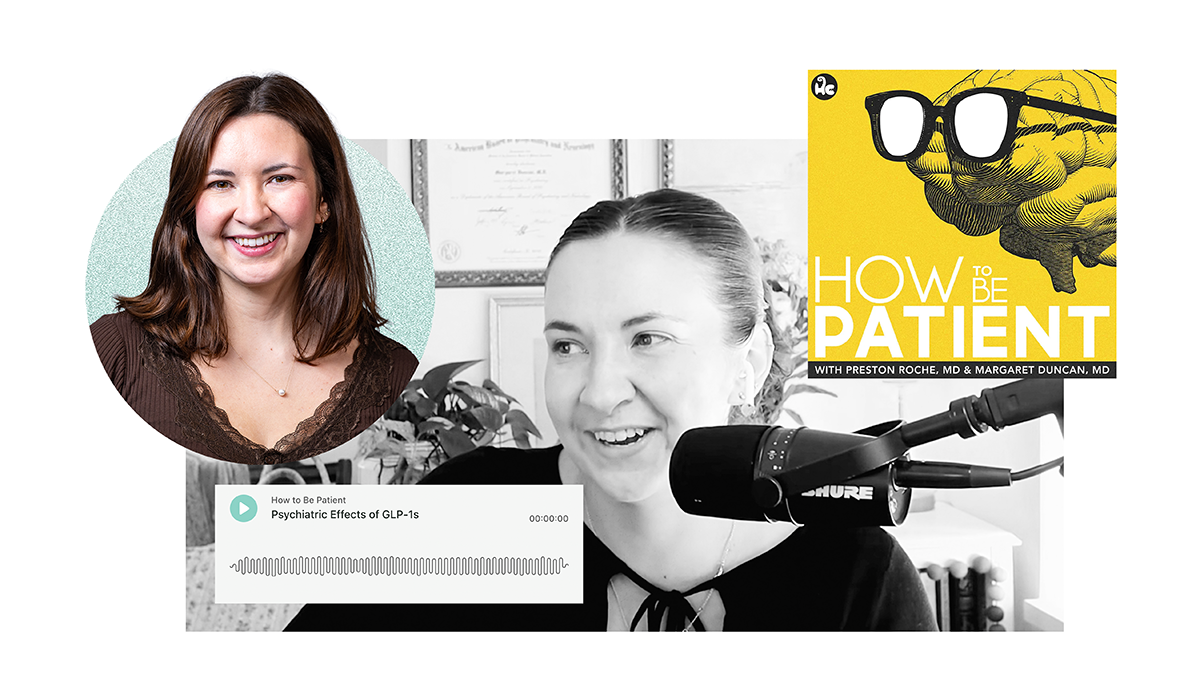
Child and adolescent psychiatry fellow at Massachusetts General Hospital and McLean Hospital, and co-host of the podcast How to Be Patient
The doctor is in … wherever you get your podcasts
One podcast episode at time, Margaret Duncan, MD ’21, is striking a balance between creative pursuits and her medical practice.
A child and adolescent psychiatry fellow at Massachusetts General Hospital and McLean Hospital in Belmont, Massachusetts, Duncan uses her day-to-day training as the inspiration to explore the practice of medicine — from the clinician’s side as well as the patient’s — and to question the systems surrounding it all. As co-host of the podcast How to Be Patient, Duncan explores a more comprehensive approach to mental health.
Duncan said she wouldn’t have taken on podcasting if she hadn’t been pushed by her friend and co-host, Preston Roche. Two years ago, Roche was approached to do a podcast by Dr. Glaucomflecken (the stage name of Will Flanary, an ophthalmologist with a knack for medical comedy), and Roche immediately asked Duncan to co-host.
“I was in my third year of residency at Harvard and thought, ‘I’m not ready — I’m not an expert!’” Duncan said. “But I was raised by a father who saw systems change throughout his decades of medical practice as a primary care physician. I was scared to do it, but if you’re going to complain about systems in healthcare and an opportunity comes along to have an impact, you have to accept — or else stop complaining.”
When the lay public seeks medical information, Duncan said, that information may come from those who are more than happy to sell a product or protocol that isn’t evidence-based. On How to Be Patient, Duncan and Roche welcome researchers who spend their lives on their studies, many of which get either blown out of proportion or ignored by the media. They ask questions like, “What do you, the person who spent the last decade or more studying this, want people to understand about your paper?”
To Duncan, transparency is so important.
“We want to be real about what it’s like to actually practice and be in medical training,” Duncan said. “Destigmatizing mental health is one thing, but we also talk openly on the podcast about what makes it frustrating to be in these systems and how to better support the longevity of healthcare workers. For us, discovering how we can all learn, build and think about the systems we’re in with more nuance is both a source of inspiration and an affirmation.”
When Duncan was in medical school at WashU Medicine, she thought the creative part of her that now makes the podcast would exist outside the margins of her life in medicine. But the very thing that she wished she could turn off then — her desire to write and create — has proven very important not only in her life, but in her career.
“If I can reiterate anything to anyone in medicine or in any demanding career where you feel as if you have to constantly be in the ‘now,’” Duncan said, “it is as the poet Mary Oliver wrote: ‘Keep some room in your heart for the unimaginable.’ These other parts of you don’t need to be truncated away from a career that you also find meaningful.”